4 minutes
5 Key Trends Accelerated by COVID-19 in China - From McKinsey & Co.’s China Consumer Report 2021
2020 was a challenging year, to say the least, and it brought about changes that have shaped economies all over the world. With China being the first country to deal with the COVID-19 crisis, its economic landscape showed several important shifts while on its way to recovery.
McKinsey & Company released its “China Consumer Report 2021. Understanding Chinese Consumers: Growth Engine of the World,” which analyzed how COVID-19 affected consumer consumption. According to the report, five trends that were already growing strong, were observed to have radically accelerated because of the pandemic:
1. Digitization
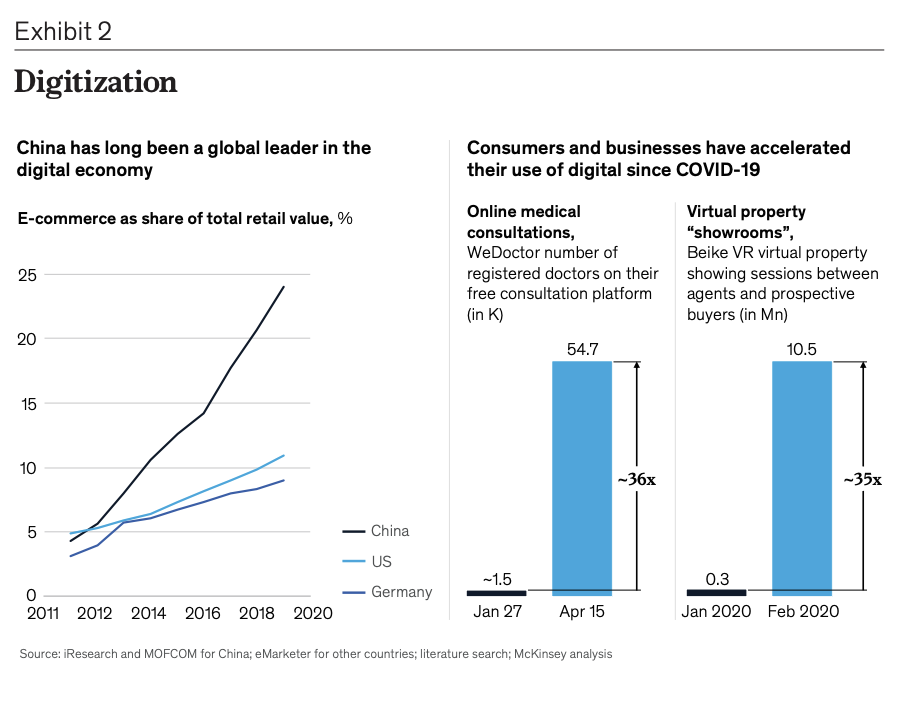
China was already a leader in the digital economy even before COVID-19 — accounting for 45% of global e-commerce transactions in 2018 and with 3x more mobile payments penetration than in the US. But as a result of the pandemic, digital developments have accelerated. Consumers have shown increased use of digital technologies, pushing digital tools at the center of most operating models. According to their mobile surveys, “about 55 percent are likely to continue buying more groceries online after the peak of the crisis”. Now, digitization of business-to-consumer (B2C) applications and channels has become of great importance, and even business-to-business (B2B) processes and the areas requiring significant physical interactions are catching on. Digital solutions have emerged that are pushing the rapid growth of a “stay-at-home economy”, and altering the consumer and employee behavior in manners that are likely to stay.
2. Declining Global Exposure
Even before COVID-19, China had been reducing its relative exposure to the world and shifting toward a domestic consumer market. Its “decoupling” from the US raised risks and uncertainties, and COVID-19 may have accelerated this trend. However, the full picture is still more nuanced as China will still continue to require global technology to maintain growth, while the size and growth potential of the Chinese market will remain important to the rest of the world.
3. Rising Competitive Intensity
The epidemic has given rise to competitive intensity among China’s leading companies. The “Superstar Effect”, which means the company’s dominance is often short-lived, appears to be growing even more evident because of cutthroat competition. Mostly agile and tech savvy companies were able to endure and find business opportunities amidst the crisis. The report states that, “According to a survey of small- and medium-sized companies (SMEs) by Peking University in February, around 20 percent of respondents said they would not be able to endure beyond a month on a cashflow basis, while 60 percent would not last beyond a quarter, should the pandemic have continued”.
4. Consumers Come of age
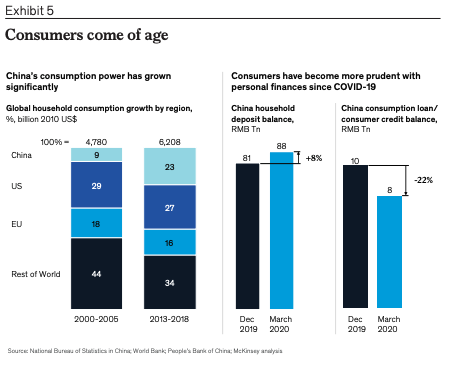
The report suggests that spending habits among Chinese consumers in their 20s and 30s have changed. The affluent younger generation who have been a major driver in global consumption are becoming more prudent and health conscious. Based on one survey, “42% of young consumers intend to save more as a result of the virus” and that “more than 70% of respondents in our COVD-19 consumer survey will continue to spend more time and money purchasing safe and eco-friendly products, while three-quarters want to eat more healthily after the crisis”.
5. Private and Social Sectors Step Up
In the wake of COVID-19, China’s private and social sectors are making large contributions and playing a more vital role to socioeconomic recovery efforts. It is important to note the key differences in the responses to SARS in 2003, where the Chinese government led the majority of the recovery efforts, while in the COVID-19 crisis of 2020, there was a joint effort between the government and large private companies. The report indicates that “the private sector contributes close to two-thirds of China’s economic growth, and 90% of new jobs, illustrating a significant shift in the balance of economic power. It is apparent that COVID-19 has accelerated pre-existing trends and despite the lingering uncertainty, one thing is clear: China will continue to be a major driver in global consumption and growth.